Showing posts with label outward facing. Show all posts

Sunday, 13 March 2016

Principals receive a warm welcome in Taupo

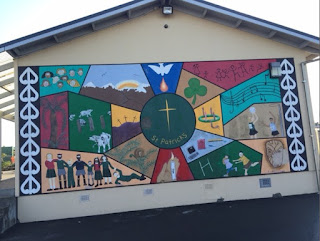
The newly designed logo for the school.
                                                                                         
The New Zealand Catholic Primary Principal's Association (NZCPPA) Executive members visited St Patrick's school in Taupo during their Term 1 meeting days in March. Thanks to Danny Nichols, the principal of St Patrick's, for opening up his school to us all. 
Michael Mokai the outgoing president of the NZCPPA Executive gave a heartfelt response to the tamariki after they welcomed the group with a moving waiata and kapahaka performance.
After celebrating mass with the local parishioners, the principals joined the staff for morning tea and toured the school.
Here are a some photos from the visit.
                                            

Sunday, 16 August 2015

Catholic Character review from the inside looking out


Being invited to participate in a Catholic education review is an excellent learning experience. I would encourage every leader in a Catholic school to grab such an opportunity. Spending time in the presence of lead reviewer Paul Ferris,QSM and his experienced team, Rosemary Burke and Fr Wayne Healey was a privilege. Special thanks to the principal of St Patrick's Invercargill, Callan Goodall and his enthusiastic staff and children who made us all feel very welcome. Thanks to the Dunedin Diocese for their willingness to open up the review process. I came away from the review feeling humbled by this rich learning experience and motivated to share my learning with our school community.

The following information was taken from my own notes during the review.
Left to right: Fr Wayne Healey, Rosemary Burke & Paul Ferris

As you walk into the school, it is clear that it is "unabashedly Catholic".
Brother Sir Patrick Lynch shared his thoughts around this at the Catholic Convention
These photos give you an idea of the visual impact the school's Catholic identity makes as you enter the main office, school hall and playground.
Top row - Entrance to St Patrick's School, bottom row -new prayer garden.
One of the eye catching murals displayed in the playground that emanate the rich Catholicity of the school.
More of the murals out in the playground and in the school hall that link to the gospel values and the rich culture and tradition of the school community.
Board of Trustees 
As part of the review, it is necessary to meet with the board. This is an opportunity for the board to share their passion for the Catholic school that they govern. Here are some examples of the questions that were put to the board:
What does the school do really well in keeping with its Catholic ethos ?
What has changed and improved since the last review ?
What has the board done around the formation of its teachers ?
Who holds the tagged positions and do their job descriptions reflect their commitment ?
Do the board know what papers that the teachers have studied ?
What do the board know about the Catholic special character budget ?
How is the board assured the appraisal system focuses on growth in special character and quality teaching ?
How does the special character attestation get completed ?
How often do you have a whole school mass ?
How can the board be assured that the school provides an authentic encounter with Jesus ?

Principal
This meeting commenced with a reflection on the progress since the recommendations made in the last report. I wasn't present for the whole meeting as I went and observed some teachers in action:
What evidence do you have to show the changes made in response to the last review ?
What would we see when we come back again in three years time ?
Where does your Catholic special character goal fit within your charter ?
Do you utilise the open and preference place data to guide your targets ?
Have you got links on your website and facebook page to special character resources that support parents (eg. with the sacraments) ?
Share your staff formation plan.
Does the principal and DRS have a thorough understanding of the RE teaching happening throughout the school ? Does the principal challenge the quality of feedback to ensure healthy professional growth ?
Does your data around RE support adjustments to teaching practice ?

Teaching Observations
Is there connection, engagement and participation ?
Where does the lesson and the planning fit within the strand ?
Are the children excited to learn and does the teacher demonstrate enthusiasm and passion for RE and their faith ?

Director of Religious Education (DRS)
What has developed since the last review ?
How do you know that there is quality RE teaching happening around the school ?
How do we adapt teaching practice to ensure that the children are encountering Christ in the classrooms (NZCB The Catholic Education of School-Age Children "puts the encounter with Jesus at the centre of Catholic education" page 2 ).

Are the DRS reports to the board more than a diary of events ? Do they assure the board that there is an ability within the school to make a difference ? 
Where is the voice of the child as learner ? Do you find out what is working well and not working well for the children ?
Formation of teachers - Have you got a record of the accreditation hours for the teachers ? Have you analysed it and developed targets to go forward based on this information ?
Have you shared this with the board?
How do you know that prayer takes place every morning and how is this developed ?
Parish School Relationship - What level of input does the school get into the liturgy ?
Are the teachers aware of the different criteria for preference of enrolment and are they teaching to this ?

Learn how staff and board prepared for our own recent Catholic review here. 

This review experience has emphasised the importance of our Catholic schools sharing resources and working together (another post with this same message). 
We need to continually nudge each other to move out of our comfort zones and ensure that our Catholic schools can proclaim the joy of the Gospel uniquely and powerfully with Jesus Christ at the centre of all that we do. We need to inject our passion and energy for our Catholic faith into our schools so that our children and families truly encounter the living God.

“School can and must be a catalyst, it must be a place of encounter and convergence of the entire educating community, with the sole objective of training and helping to develop mature people who are simple, competent and honest, who know how to live with fidelity, who can live life as a response to God’s call, and their future profession as a service to society ” (Pope Francis, 2013). 


Saturday, 21 February 2015

Can you say yes to these 5 signs of culturally responsive learning environments ?

We are only three weeks into the new school year and have already held a Family Learning Hui ( Maori for gathering ), a Board of Trustees meeting and a Pasifiki Fono (Polynesian for meeting). We have our Filipino Pagsasama (Tagalog for gathering) also booked in and have plans for our first Chinese meeting during the first six weeks of  term.

Inclusive educators are reflective and pro active and willing to adapt to the evolving needs of their community. Valuing and respecting the immense taonga (Maori for treasure ) of people resources that exist within our own family groups are vital. Utilising these powerful human resources  can create invaluable support networks for our vulnerable, priority learners who are struggling to adjust to unfamiliar languages, culture and environments.

This is an example of such a network in action already this year.

A new child was struggling to settle into school. The school pastoral liaison person visited the family. The class teacher and the principal made contact with the school Pasifika parent leader. The planned Pasifika fono was immediately moved forward. One of the leaders visited the new family and personally invited them to attend the fono. At the fono, the principal was able to openly ask for support for the new child and family. A discussion was held in Tongan and a number of parents and other children were willing to offer support. The outcome was that the whole group wanted to help the new child to settle in. A meeting was arranged for two of the leaders to meet with the new parent and the class teacher the following day at school. One of the senior school children offered to be available to help and support the new child. Within the first three weeks of the new school year, a safety net of care and love with direction and purpose was activated from the taonga of people resources already existing within the school community. 


Culturally responsive checklist for educators. Can you say a resounding  yes to these 5 indicators ?  

Do you...... 

1. Connect with learners and build sincere and authentic relationships with them and their families ( smile, greet them in their own language, learn to pronounce their name correctly, make home visits, attend school cultural meetings, community gatherings and events outside of your own classroom or workplace ) ?

2. Ensure that all the learning spaces have visual connectors ( artwork, pictures,signs, maps, symbols, photos ) that learners from other cultures ( representative of all cultures within your class or school ) can immediately connect with ?

3. Include stories, texts, inquiries and projects that are inclusive with themes that relate to other cultures in your teaching and learning ?

4. Walk in your learner's shoes and see learning through their eyes and adapt teaching and learning accordingly. How would you feel, what would you think, hear and see if you were suddenly expected to adapt and learn or work in an unfamiliar cultural environment ?

5. Have a growth mindset and an open heart and are willing to embrace new learning from other cultures that can genuinely nourish and broaden your own life skills and values ?

Can you add to the list ? Please share more ways to create culturally responsive environments in the comment box below.


Sunday, 1 February 2015

OPEN Ch 7 Pt 2 : 5 Commonalities of Innovative Workplaces

'The most innovative companies in the world regard work as learning'.

Learning environments that offer opportunities to explore, trial, play and collaborate allow innovation and creativity to flourish for all learners (staff and students). This was the focus of my blogpost based on the first part of Chapter 7 in my chapter by chapter review of the book that Sir Ken Robinson describes as a 'revelation' - OPEN: How we'll work, live and learn in the future by David Price.

Screenshot taken from David's site: 'Engaged Learning'

So much change has happened in our workplace since I wrote that post a few months ago. When I made a commitment to share my chapter by chapter reflections about this powerful book ; I didn't foresee the immense and immediate impact that it would have on the way we work and learn in our own educational setting.

Although the book shares how we will work, live and learn in the future, the future has transformed into the 'now' for us. Our 'open' changes are clearly evident yet continually evolving. They are purposeful and dynamic yet fluid. Most importantly, everyone: students, parents and staff are key players and contributors in our redesigned playing and learning spaces. 

What have we done that is working for us ?

We have held on tightly to our why goal: To engage every student in deep learning for success. We have loosened the restrictions of agenda filled, frequent, business like staff ' professional development ' meetings and opened a window to let in fresh air, space and time to 'explore, trial, play and collaborate to allow innovation and creativity to flourish for all of us. This window of opportunity has now evolved into a large sliding door (metaphorically speaking only !).


Image from indYouth home decorating site
A sliding door in architecture and construction, is a large glass window opening in a structure that provide door access from a room to the outdoors, fresh air, and copious natural light (wikipedia)
  
What exactly does this mean for us as educators ? We have opened our minds and our hearts to the new learning and growth that comes when students, staff, families, parishes, networks of schools and global learning communities collaborate as one on an equal playing field.

In 2015 more than ever before, we are truly 'Open' in all that we do in our educational setting. Hubs of teachers are sharing planning, teaching and learning within collaborative learning spaces and online. Our Teaching and Learning Site is a public site that shares absolutely everything. There are no secrets. We use the SOFT (Sharing, Open, Free, Trust) values described in Chapter 3 to guide the way we work.

In Chapter 7 Part 2, Price shares examples of business workplaces that use the SOFT values as they move from closed to 'open' systems. 

Here are 5 commonalities of very successful business workplaces :
  1.  All decisions are made in a work culture using a 'living - systems lens'. This way you get leaders who approach change as if they were growing something, rather than just 'changing' something. (Senge 1999 via Price 2013 p140-141). This video expands on this concept and links to Wheatley's description of 'self- organising living systems that have the capacity to respond continuously to change'.
  2. Collaboration and team work are 'non negotiable'. Social media is encouraged and used in these workplaces. This 'is facilitating more face-to-face sharing than ever before.' (p143) 
  3. Personal growth opportunities and time to play as well as a culture that allows for 'freedom to fail ' (p150) leads to new learning and innovation opportunities.
  4. Trust provides the 'safety-net for innovation' and is the lead source of employee motivation (p151). 
  5. Institutions that share and expose what they are doing with the public improve, grow and develop the fastest (p155)
'The most innovative companies in the world regard work as learning'.

Is work regarded as learning in your workplace? How?

What about "Open Learning in Education"? That's the theme for Chapter 8 and my next review of OPEN: How we'll work, live and learn in the future by David Price.

Monday, 12 January 2015

Out with the desk; changing the principal's office into a collaborative meeting hub

This was the introduction to a recent post about supporting parents through school wide learning and change: In 2015 every teacher at St Joseph's will teach in partnership with one or more teachers in collaborative learning hubs. Teaching and learning across the school from Year One to Year Eight will go live and be fully accessible to everyone inside and outside the school via a dedicated teaching and learning site.

What does this mean for me as a leader? 
While the staff are frantically rearranging and redesigning learning spaces preparing for the new school year, I have been proactively revamping my traditional principal's office.

First action - OUT WITH DESK !!
.
I have never felt comfortable talking to anyone including students from behind a desk. I have always made a point of coming forward and standing beside or sitting with a visitor at a meeting table. While I was teaching at the De Blijberg Jenaplan School in Rotterdam in the 90's, I learnt to sit alongside learners. We would create a morning sharing circle 'cring' with our chairs rather than the archetypal junior classroom practice of the teacher on a chair talking to the students on the floor.
The Jenaplan schools operate according to 20 basic principles with the first being that each human being is unique. Therefore, each child and each adult has an irreplaceable value and a special dignity .

I also recall several years ago as a first time principal, my eagerness to visit and learn from an experienced principal. Unfortunately my enthusiasm was dampened before we even met. First of all, I was asked to wait for quite some time in the visitor's part of the office. This is understandable in the life of a 'busy' principal. Then I was invited into the principal's office to sit on a very small chair some distance from the principal who proceeded to speak to me from behind a very large desk. I felt disconnected and disesteemed. Needless to say, I went away feeling disillusioned yet determined to ensure I didn't duplicate that experience for any of my future visitors. 

Fast forward to 2014 when I arranged to visit @MarkMoorhouseMM principal of  Rochdale, United Kingdom. Mark took time out of his busy day to sit alongside me and share some of the inspirational practices happening at Matthew Moss High School. It was a sheer pleasure to travel to the other side of the world and be treated like royalty. I am still sharing my learning from this visit.

What has all of this got to do with removing my office desk? As a leader, I need to be a role model for my team. Part of our school wide change for 2015 means that we are moving away from single cell teaching spaces to team teaching learning hubs. Inspired by
David PriceOBE author of the powerful book  OPEN: How we'll work, live and learn in the future, we will become a much more open and collaborative school this year. In order to make this happen, we agreed to leave behind symbols of traditional classroom settings in our quest to develop agentic learning spaces. Along with other environmental changes, teacher's desks will be removed from learning spaces in order to create equally shared spaces - no individual student's desks, therefore no teacher's desk!

I have now decluttered and depersonalized my conventional principal's office and aim for it to be a creative, collaborative meeting hub for all learners: staff, parents and students. This means that I aim to spend more of my time in other learning hubs around the school.

BEFORE: 'Principal's office'  - with desk removed


AFTER: Redesignated 'Collaborative Meeting Hub'

We are about to revisit our job descriptions to reflect our team teaching roles in the new learning hubs. This is also a chance to revisit our role as senior leaders as we redefine our place as educators and leaders in a school culture focused on engagement in deep learning and success in this digital age. As leaders, we also need to ensure that these environments are equally as engaging and empowering for our adult learners too.

Next on the to do list: order a new sign to replace the existing 'principal' sign on the office door.

Have you redefined your office space and your job description? I am interested in learning more from you. Please share your experiences.


Tuesday, 30 December 2014

Principal as learner on an energising rollercoaster ride; why 2014 has surpassed any other

I have been inspired to record my reflections after reading this blogpost by Eric @E_Sheninger entitled A Principal's reflections: 2014 was one wild ride.

My personal goal as a principal of  six years in 2013, was to achieve a 4-5 year Education review (ERO) and be recognized as a high performing school. After finishing last year on a high with the teaching and learning of our passionate and hardworking team of staff being acknowledged by an outstanding ERO report , I didn't think that anything in my career could match this. Well, I was wrong. 2013 pales into insignificance against the prolific personal and school wide learning that took place in 2014.

Image credit:http://megapapers.com/news/roller-coaster-reaching-new-heights/

Hold on tight and share the roller coaster ride - the new learning highs and the reflective lows that provided a chance to take a breath before the next invigorating high.

Here are some personal, professional reflections from 2014:
  • Taking a 10 week principal sabbatical in Term 1 (Feb-April). This gave me the chance to travel and be inspired by enthusiastic colleagues around the world. Special thanks to @MarkMoorhouseMM principal @MatthewMossHigh in the UK who introduced me to Carol Dweck's growth mindset work, project based learning and transactional analysis. My sabbatical experience led to further studies and I am now studying a Masters of Educational Leadership part time.
  • Having time away from school during my sabbatical gave me a chance to explore and embrace social media and digital learning. I joined Twitter and sent my first tweet in April. I have since shared blogposts ( I began my Principal's blog in April too) about the benefits of Twitter for educators
     
  • Connecting through Twitter with dynamic UK author David Price OBE and reading his book entitled Open: How we'll work, live and learn in the future. I challenged myself to write a blogpost about each chapter of the book. Applying my learning from this transformational resource into our workplace has contributed to our school becoming a much more open and transparent place for all learners and their families. Exciting and engaging learning developments during the months that followed my return to school (including a proliferation of class and student blogs), meant that I have only reviewed seven out of the nine chapters of Open. I will be completing my reviews early in 2015.
  • Teaching myself to create a 4 minute video encapsulating the messages from my sabbatical report. I had never made a video before, but followed the lead of a colleague @THE0BALD who had used @VideoScribeApp to create a video. I have since made several videos focused on deep engagement in learning.
    Screenshot from my sabbatical video

  • Leading a cluster of schools as part of a Learning and Change network (LCN) with @janine simpson26 and Rob Mill. This has provided further exposure to innovative teaching and learning research and practice as well as inspired us to challenge the ways we engage with our learners and families.  Parent meetings evolved into our signature Family Learning Huis (Maori name for gathering) that have supported our transition to Collaborative Team Teaching Learning Hubs for 2015 further inspired by a visit to Tim Lovelock @timl27 and the team at Myross Bush School.
  • Presentations to share my learning to the Otago and Southland Catholic Principal gathering in Invercargill, Future Focused Learning Workshop in Dunedin (with @brian_annan,@NickyRyan11 @MSBeenz & @annekenn  North Otago Probus in Oamaru, Whitestone Women's Dinner Club, Catholic Principal's Convention in Wellington and the LCN Southern Regional meeting in Christchurch.
  • An invitation to represent the North Otago Pasifika Cluster and give a presentation with our board chairperson to guests attending the University of Canterbury Pasifika Talanoa Success Fono (Pasifika name for gathering) in Christchurch
  • An invitation to publish an article in the Aoraki Catholic Journal
  • An invitation to be part of an LCN reference group at the University of Auckland with the vibrant @brian_annan , @mareswootts, @kellylayton99, @hkkh18, @michaeljfletch, @JeanAnnAnnan & more and be nominated to contribute to the working party planning a National LCN Conference for 2015
  • Working with student Learning Leaders to remain firmly focused on our school wide goal To engage every student in deep learning for success @StJoesOamru
  • Nurturing staff and student leadership across the school. Both of our Deputy Principals (@siobhanp2 and @LorraineFRees) being appointed to Principal roles, promotion within our talented teaching team (@sburke7 & Paul Cartlidge) and the heart-warming graduation of our talented Year 8 students (every one of them is interviewed and appointed to a leadership role ). 

 Opening up to the engaging world beyond the school walls has reignited my passion and love for learning. Through embracing social media and digital technology, I feel confident to take our school further forward in 2015 with the support of our capable staff. If we wish to fully prepare our learners to succeed at high school and beyond, then as leaders we must be willing to be passionate activators of deliberate learning and change. 

A HUGE thank you to everyone who has contributed to my exciting roller-coaster ride of learning and change this year.