Showing posts with label flipped. Show all posts

Saturday, 19 November 2016

A renewed community vision emerges in the seventh week...

  Six weeks of collaboration followed by time for rest and reflection in the seventh week, contribute to a renewed community vision.
  When I came home and announced to my family that I had been at my new school for seven weeks, they reminded me that seven was a very special number. During my seventh week as principal of St Patrick's school in Murrumbeena, Melbourne, our renewed community vision began to emerge.
  During 2014, Lorraine Frances-Rees and I collaborated on an article for the Catholic Education New Zealand magazine, Aoraki (the article can be found on pages 9 - 16) or  Here is a link to the article. The article was in relation to change initiatives that began to evolve as an outcome of my sabbatical after seven years as a principal in New Zealand. It was then that I became enlightened about the number seven from a biblical perspective. Lorraine wrote about God resting on the seventh day in Genesis and the resting of fields every seven years in Leviticus. You can read the article by going to page 11 of this link.

The cover of the original Aoraki publication (left) and the new cover (right).

What has emerged in the seventh week at St Patrick's school ?
This is a summary of the visioning journey so far. The link to an earlier post, explains the initial process with staff: Individual culture and context drives the visioning process.

  Staff shared their thoughts and ideas in relation to four probe questions linked to the school's existing vision statements and other pertinent documents. Then staff followed the 10/4 voting process. A fifth probe question was later introduced in response to further discussions - If you had a magic wand to transform the school buildings, learning spaces and playground, what would you like to see change ?
  Interested parents who joined our newly formed POPE (Parents Open Partners in Education) group also reflected on the probe questions. Members of the Parish Education Board shared their thoughts and ideas too. Students contributed through meetings and surveys.

Staff voting during the visioning session.


All of the data was summarised and the outcomes shared with staff. Here is a link to the summary.

  During this time, we received the new Catholic Education Melbourne Learning and Teaching Framework, Horizons of Hope. It is a distinctive document, designed to support excellence in teaching and learning within the context of the central vision of Catholic education to carry on the mission of Jesus. I prepared a presentation, incorporating the key messages from Horizons of Hope, to guide staff as they formulate a succinct vision statement and future actions for our community. Here is the presentation. Slide 6 shows the link to Horizons of Hope.

Thanks go to Lorraine Frances-Rees for slides 8,10,11,13 adapted from our presentation at the
Catholic Education Convention, New Zealand, 2015.
You can access the presentation Authentic Catholic Leadership at this link.

  Below is a draft vision statement, a contribution from one group of staff as they began to plan actions going forward. This statement links very well with the existing school logo and encompasses the meaning of the five existing vision statements (Slide 7 above). We hope to have one succinct statement, easily articulated by the whole community. The statement could be the one that guides our future plans and actions.
Continual collaboration within a connected community allows a renewed vision to emerge in the seventh week...


Our existing values will be revisited as we link them to our renewed vision for all learners.


Tuesday, 21 June 2016

OSCPPA Strategic Visioning Day; Facing the Future Together

It is my privilege to plan and lead this visioning day in Cromwell as my last official duty for the Otago Southland Catholic Primary Principal Association (OSCPPA) before I leave for Melbourne.

In order to ensure that the strategic visioning day is as constructive as possible for participants from the OSCPPA, all participants are asked to prepare in advance. This is similar to a flipped learning experience that some of us use for our staff meetings and in our classrooms to ensure we are time efficient and purposeful.

Here is a link to the existing constitution OSCPPA Constitution. Please read through this for your own information. Thanks Michelle for sourcing this from past president Alan Watts.


Please read through the NZCPPA visioning experience at this link. This will help you understand how this inclusive process works. Recognition is made to Mary Wilson and Teresa Edwards whose resources I have used to plan and prepare for the day. Special thanks to Paul Richardson who helped to prepare the original draft outline and probe questions. Thanks to all OSCPPA principals who have a growth mindset and are committed to the Catholic education and the important role our schools play in carrying out the mission of the Church.

Outline of the Day

8:30 Venue open, hot drinks available.

9:00 Welcome and prayer

9:15 Clarification around process and key probes (adapted from objectives of OSCPPA and those shared with you at the Bishop's Forum). Keep in mind anything you see as important and ensure you bring this out in your responses.

  1. How can we work cooperatively to market, grow and ensure the continuing prominence of the Special Catholic Character of our Catholic schools ?
  2. In what ways can we nurture our links to the Diocesan office (our relationship with the Proprietor, the Catholic Education Office) beyond the Diocesan events and forums ?
  3. What are the most effective ways to promote and support Catholic professional development for principals and their schools according to needs from within the group eg. personal and spiritual well being ?
  4. How can we enable members to have equity of representation from across our Diocese on appropriate bodies and organizations, including those at local and national level ?

9:30 Divide into four balanced groups (mixed gender and mixed regions) for the Classic Brainstorming and 10/4 voting process with 20 minute sessions for each of the four probes. 


 9:40 Round 1 

10:00 Round 2

10:20 Round 3

10:40 Round 4

11:00 Coffee Break 
During this time, top two responses from each group are collated onto a master page and copy made for everyone is made. This will mean eight responses per probe.

11:30
Individually review the responses and make 10 private votes.
These are then used to collate the draft vision and goals during the lunch break.
12:00
Lunchtime
Draft vision and action plan collated. Come up with about 6 important goals and spaces for actions and next steps.


12:45-2:30
Review and include actions, timelines and plan an agreed way forward for OSCPPA


2:30
AGM Meeting based on Article 6 OSCPPA constitution

3:00 Conclusion


Sunday, 6 September 2015

Peace of mind with an external review around the corner - 5 easy steps

External reviews can cause undue worry and stress for a school community no matter how well prepared they may be. How can we as leaders, create a supportive climate and ensure peace of mind for our staff ?

In a Catholic school, we have two external reviews every three to four years. One is the mandated government education review that enables school trustees, leaders and teachers to identify the strengths and weaknesses of current performance. We had our last one of these in 2013 and will be next reviewed in 2017-2018. The other important review is the External Review of Catholic Special Character and Development. We have these every three years and we are due for one next week. You can read an earlier post on the Catholic review process by going to this link.


Challenge and be challenged
As leaders, I believe that we should always be looking at ways to challenge ourselves, have a growth mindset and "move out of our comfort zones". External reviews are an ideal opportunity to ensure that we haven't remained doing the "same old, same old" as we were doing during the previous review. However, waiting until the external review happens isn't good enough. Our system of continual internal self-reviews ensures that we remain at the "top of our game" and don't ever sit back and believe that we are "the best that we can be". Active leaders know that we can always keep growing and learning and must be authentic role models for our colleagues.

Importance of having a national Catholic voice
It is thanks to an enthusiastic and supportive team of staff, in particular our Assistant and Deputy Principals who step up when I am away, that I can accept new and challenging learning opportunities. Most recently, I was able to participate in the New Zealand Catholic Primary Principal's  Executive Meeting in Wellington. The Executive Committee is made up of two representatives from each of the six Catholic dioceses: Auckland, Hamilton, Palmerston North, Wellington, Christchurch and Dunedin. 
The meeting took place at the New Zealand Principal Federation (NZPF) offices over two and a half days. During that time, guest speakers included Denise Torrey (NZPF president), Sir Br Pat Lynch (CEO Catholic Education Office), Chris Duthie-Jung (The Catholic Institute) and Lorraine Kerr (NZSTA school trustees association president). The opportunity enabled me to reflect on the important role we play as leaders of Catholic schools, especially in ensuring there is a Catholic voice at all levels of the country. It is quite clear that greater consistency of practice in Catholic schools across New Zealand is a must - national Catholic review indicators are an excellent starting point.

Flip the process and write our own report
Keeping that in mind, our external Catholic review is an optimal time to share, showcase and review our excellent practice. We want the experience to be a valuable and positive one for all concerned and we want to be open to new learning, next steps and recommendations. We don't want to finish the review and then say, "I forgot to mention or share this..with the review team." 
Recent reflections have led me to the potential of writing our own review report. That way we can take ownership of the process and therefore experience a reassuring "peace of mind". We can write our own report and present it to the review team either before they arrive or when they arrive. (I am open to suggestions and advice - before or when they arrive ?)

5 easy steps to follow
1. Prepare a template for the final report based on the review format from a past review. It could look something like this.
2. Gather feedback from staff, board, students and parishioners. This can be done collaboratively on a google document or on large sheets of paper. 
3. Agree on recommendations as a result of this collaborative process. Be open, honest and challenging. Present your version of the report to the external review team and encourage them to refer to it during the review.
4. At the formal welcome for the review team, give the students and staff a chance to share and celebrate their roles in relation to the report. 
5. Ensure that the board of trustees share their reflections utilising the different 
dimensions of the report as a planned presentation. 

We have taken ownership of the process and believe that we are as prepared as we can be. 

The outcome is peace of mind for all concerned .


Wednesday, 18 March 2015

Family Learning Hui 2 for 2015 - committed parents, children and staff supporting and sharing learning

After an opening prayer from Mrs Dooley and a technical hitch with our data projector, Mr Cartlidge shared the Learner Licence quiz that Mrs Frances-Rees had prepared for everyone. The quiz had been posted onto the school Facebook page. The questionnaire helped parents to understand what it would it be like as a learner at the different levels of the licences we use with the children.  What would you need to be able to demonstrate in order to get to the next level of the license ?

Then we watched this video about the learning that children lose over the Summer holiday period. This shows the value of extra support by families during out of school hours learning times. Our digital Teaching and Learning Site supports out of school learning and research proves that such learning can be hugely beneficial for our children and their progress.
 
After that we watched a video of some of our children being interviewed by Mrs Frances-Rees about their learning. It was a good chance to reflect on learning for our children after seven weeks of our new collaborative approach to learning at St Joseph's.

Then Mrs Brookes and Miss Clouston shared information about the junior Reading Eggs programme and Mathletics. Everyone had a chance to explore these sites using the junior school ipads.

Miss Clouston also spoke to some of these slides from this Mathletics slideshow. http://www.slideshare.net/karen3038712/mathletics-blog-presentation           

    
We finished with a reminder of how to comment on blogs. This is the video that Mannix made last year. We offfered personal support from staff as well.
Mannix’s video for blog instructions: https://youtu.be/mWAleYiSkfk


We finished by thanking families and staff for their support and reminded them that they could contribute to the agenda at our next Family Learning Hui in Term 2.


Monday, 16 March 2015

Engaging Learning Spaces ELS's: 5 questions on the eve of our first open morning for parents

We are continually striving to stay focused on our school wide goal : Engage every student in deep learning for success
Seven weeks ago, we launched our new 'Engaging Learning Spaces' (ELS's) across the school from Year One to Year Eight.
In a valiant effort to support parents to understand how our collaborative team teaching spaces operate, we planned some open mornings.

I am writing this post on the eve of our very first open morning and wondering:

1.Will any parents actually turn up?
 We have advertised it on our calendar since the start of the year. It has been in our newsblog and on our Facebook page.

2. If they do come along, will they be open to understanding how the ELS's work ? 
 We hope that the support we have provided through the Family Learning Huis and the transparency on the Teaching and Learning site will help.


 3. Will they be brave enough to ask questions ?
 It will be up to us to create the environment where they feel at ease to ask questions and make comments. We will need to be prepared for challenging questions.

 4. Will they be able to link what they see to the planning on the Teaching & Learning Site ?
 We will be able to point this out before the tour starts by having a quick look together on the site and seeing what we expect to be happening in the ELE's.


5. How will our teachers and students feel about the experience ?
 We have to remember to be supportive of our staff and students and remind parents and visitors that the staff and students might feel a little nervous with us around. Hopefully, everyone will respect each others feelings. After all, "respect" is one of our school values.

This afternoon, Lorraine Frances-Rees and I gave a presentation to staff at St Joseph's in Timaru (an hour north of Oamaru). We shared our journey from the past few years in relation to our ELS's. Their staff will be coming to visit us in a few weeks time to see our learning hubs in action. Our open morning for parents will be an excellent opportunity for all of us to reflect and review on how our students are engaging in deep learning for success as we continue to strive for transparency around everything we do.


I will let you know what and who tomorrow brings...........

Friday, 24 October 2014

Myross Bush School in Action

I travelled south for 315 km to Myross Bush School (MBS) and combined it with a Catholic principal's meeting in Invercargill (10km further south) on the following day. The long  journey was well worth it. Having heard Tim Lovelock and his team share their learning philosophy a few weeks earlier at a regional learning and change network meeting in Dunedin, and with our staff eager to team teach for 2015, I was looking forward to seeing MBS in action. Read more here or watch the photo slideshow below.
A breakdown of the MBS philosopy in post - it form

Although Tim described MBS as a school with very traditional buildings, the creative transformation of the buildings and grounds with multicolored poles and bright yellow signs gave the school a contemporary and welcoming feel.

I was greeted warmly by Tim (principal) and Evelyn (DP) and grateful for them giving up over two hours of their precious time during my visit. All of the staff and the children made me feel very welcome.
The breakdown of the MBS shared philosophy was evident on the large whiteboard in the staff room.This was the groundwork behind the school's vision that is now articulated around a 'Simon Senek golden circle' of why,what, how.


Junior boys screening up their milk video for all of us to view

I was interested in learning how the apple TV connector in the staff room made streaming from IOS devices so easy. Tim and Evelyn demonstrated by streaming up some of my photos immediately from my i phone. The highlight for me later on was seeing a few of the junior boys 'screen up' a milk video they had just made on their ipad and share it on the TV in the classroom. Not only was the video very engaging but the screen view was excellent as well.
Here are some answers to the questions my staff asked about MBS. We will definitely organise for our  junior and senior teams to visit. 
Maths planning template on ipad
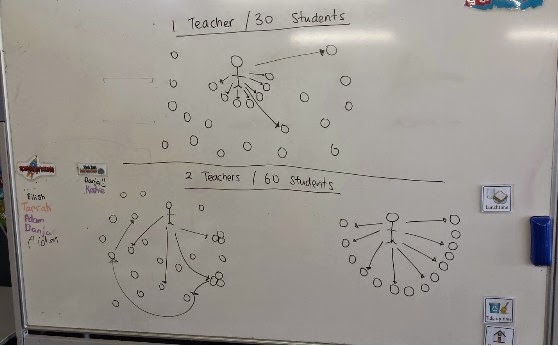
Using single cell classrooms for team teaching - how is it different from cross-setting / streaming?  How is it different from the traditional teacher roaming / group teaching set up? 

They are not running single rooms with single sets of resources. You will have different learners during the day. You treat the two classes as one large class. For example, a class of 56 with 2 teachers. Each class has one teacher allocated for pastoral care & the daily register and the written reports are the only times that you work on your own. If there’s a meeting then they aim for both teachers to be present. apart from parent interviews.

An example of the junior action station record that they highlight
Two classrooms become one: all resources, furniture etc all go into one room and you need to reduce the doubling up of resources. The rooms were initially 'gutted'. There are no teacher desks and no filing cabinets. The rooms were made more colorful. There are individual blogs from Year 1. There is a blogger app that the juniors use to take a photo (one a week from Yr 1). This becomes a record of their progress over six years at school. This is like a sample book of progress.

What have they done to their spaces to make them suit particular learning styles and learning activities? No class sets of desks, movable learning spaces, kids design the two rooms - one for workshop, one for action station. The rooms change regularly and everyone needs to be flexible. Less is more.

How is the furniture arranged/organised-is there any? How are the rooms laid out? How do they manage the team teaching aspect? What does it look like? All planning is on the iPad with notabliity.School expectations are a guide.Whatever works for the teaching pair goes and if they can show that it meets the needs of the learners then that's fine. Each teacher has an iPad and laptop. The teachers working in partnership with the i pads make the single cell rooms become open plan.

How do the children know the expectations? How are the digital next steps made accessible/managed? Can we have a copy of what the children use? Google apps, learning pathways - say it proportions/ratio in maths for learning. First they sit together as a group. the teacher asks them what they already know and what they need to work on next. That informs the workshop. Then they must show evidence of what they can do via links on their blogs. Learners opt in and out of workshops and digital pathway.Learners move across different groups. They Integrate mixed ability workshops and continually build up evidence. They got rid of ultranet and now they just put all evidence on individual blogs. There is a governance site for the board and a staff pedagogy site. Both of these sites are private.

How did you get the whole staff on board and motivated to adopt changes in practice?It morphed through pedagogy and practice. 

How do you keep track of what each child has done when opting in and out of workshops? Originally learners moved names on Velcro on boards but they are now moving away from this to total student agency. Activity tracking sheets and digital group planning records are used.

How much support is given to children when identifying their next steps? Support happens with the workshop teacher. Teachers agree to swap weekly, fortnightly and plan together.

Do you find assessing children much easier with another teacher in the room? Only one teacher still in each room but you can get two opinions and you can discuss progress and learning together.

I'd like to express my sincere thanks to Tim and Evelyn and their team for making me feel so welcome during my visit. I am further inspired to be bold and brave and keep creating those ripples that will keep our learners engaged in deep learning for success.


Tuesday, 16 September 2014

Flip the MLE building ; Team teaching can work with single cell classrooms.

As a future focused principal of a traditional style school building in Oamaru, listening to Tim Lovelock and his DP's share learning at Myross Bush school in the far south was sheer bliss. At St Joseph's, we have an enthusiastic, pedagogically switched on staff keen to experience team teaching but only two of our junior classes have been able to make it happen. We thought that we would have to knock down walls between classrooms. At Myross Bush school, effective team teaching happens within single cell classrooms. Learn more from my notes here.
Team teaching model at Myross Bush school, Invercargill
  • Children experience one – three teachers a day and are moving around different spaces. School looks traditional on the outside but revolutionized inside.
  • Team teaching is  visible to each other and to the kids – totally transparent. No busy stuff!!
  • What is team teaching? We share it with the parents and show them what it looks like.
  • Team teaching helps. It started with the new entrants and moved through the school. Teachers have agency. No planning checks. Come and sit in the room and talk through your programme.
  • Team teaching makes it sustainable – each pair makes a philosophy on how they work together. Keep changing and mixing teams. Have different combinations and strengths.
  • Team teaching but still in single cells classrooms.
  • Myross Bush's school vision is articulated around Simon Senek's golden circle of why, what, how.
  • Philosophy based on Dean Finks Sustainable Leadership
  • Attend U learn as a whole staff – immersed in future focused learning as a staff and all have a growth mindset. See expert practitioners in action.
  • Child is always at the centre and learning all around the child. What sustains and compliments it?
  • Always go back to the why and the pedagogy to check they are on track.
  • One teacher in the cave/workshop room teaches traditional groups. Opportunities for kids to opt in and out.
  • Workstation/ action station sheets, other teacher alongside/ flipped learning model
  • Agency really important – learning centredness to opt in and out of workshops
  • Action research alive, no place to hide when you team teach and plan together
  • Environment has changed to aide the why and thus a MLE. Cloak bays have change to become extra classroom spaces
  • Digital efficacy – bring it back to the why
  • High agency & low agency students paired up
  • Use SOLO thinking taxonomy for everything
  • Students Hyperlink evidence from goals on progression to their blogs to share with whanau
  • Prefer blogs as its totally open compared to ultranet (closed network). Parents RSS feed by using cellphone numbers when new blogposts come up.
  • BYOD More than the device-but why you want to use it and what you want to do with it?
  • What is it you want to do with it? – go with a tool that will give you the most connection over time, teacher dashboard,
  • Have a go together as a staff. Just jump in. Won’t role out an official BYOD policy unless we know the why, what and how.
  • Alvin Toffler quote ......... shared with parents: 'cannot learn and unlearn, and relearn'
  • It’s NOT about the thing that you want them to bring ie. The device. 
  • SOLO – Ask children, where you think your SOLO thinking is and why do  you think you are there?
  • You don’t always need a rubric for everything.
  • Don’t talk about reading , writing and maths but talk about ‘thinking and learning via SOLO'.
  • Kids aren't pigeonholed into the red reading group.
  • Numeracy is focussed on agency groups rather than ability groups in the senior school
  • Movement within workshops all the time.
  • Materials for maths at Solo 1 etc Solo stations – prestructural using materials
  • Keep SOLO simple.
  • One day a term is an inquiry time for a team as well as crt. Time out of your room as a team of 4.
  • Apply the key competencies to staff as adults – ask questions!!!! Powerful and hard conversations.
  • Growth mindset http://prezi.com/fqwtgh3cfnu_/growth-mindset/
  • Why? – We keep coming back to it as a staff.
  • Give staff time and space to experience everything together as a staff.
  • New staff: We look for potential and initiative. Can they think outside the square ?
  • Learner Licenses : Creates accountability for learners. Only level 3,4,5 can choose  independently Not reflective on learning ability based on solo taxonomy. How you work fits in with how you think.
Next steps for us: Visit Myross Bush as a staff and learn more


Wednesday, 9 July 2014

Reflections on Future Focused Learning with Dr Brian Annan and Learner Agency

I am a big believer in being open and transparent about learning and have found that blogs and Twitter are ideal platforms for publicly sharing knowledge as well as learning globally from others. They also contribute to making knowledge equitable, when resourcing constraints can become barriers to learning. As long as you accept that my words are my interpretation and reflection of my experiences, then together we can create and drive positive learning and change. I also welcome suggestions, views or feedback that will support my learning. Please comment below.

I was privileged to be invited by Margaret-Anne Barnett (MOE Principal Adviser Future-Focused Learning & Digital learning Technologies) to a Building Capability in Modern Learning Practices Workshop held in Dunedin on the 3rd July 2014. 

Preparation for the workshop and discussion required us to share a 5 minute reflection on the following:
1. What got you started?
2. What were the drivers?
3. What were the barriers?
4. What are you learning about the process of change?
5. How could change of this magnitude be supported across the system – what would you have found most useful?

Some pre-workshop reading recommendations were also shared with us:
The workshop was facilitated by Dr Brian Annan, Programme Director of Learning & Change Networks (LCN), Faculty of Education Auckland University. An important aspect of Brian’s leadership is to encourage participants to link into global networks so as not to reinvent the wheel.

I had already worked with Brian as part of the Southern Regional LCN and Whitestone LCN networks. Brian also provided feedback for me on my sabbatical report.

Brian presenting the first activity
In the first interactive activity, Brian encouraged us to share our answers to the questions above in just 60 seconds. Brian actually timed us ! We then had to compare our experience with the demand in the current digital world for "just now" learning.

Brian asked me to share the 4 minute video that I had created to encapsulate my 6,000 word sabbatical report around deep engagement in learning. Here is the link to the video.

The question was posed - Could our learners create a one minute video to share their learning and change priorities as a form of self-evaluation ?
Brian's question was a challenge for me to share my learning from the day in a one minute video. 
Here is a link to the video I created in response to this challenge.


Here is a link to a video I created about the purpose and benefit of the NZ Learning and Change Network strategy for another task that Brian challenged me with.


Brian emphasised that the term "21st Century learning" was outdated and that it was time to make reference to "future focused learning".
A discussion evolved around the place of the instructional core in the ecology of learning.
Below is the diagram ( I created for my original video) that we discussed that shows where the instructional core fits into the ecology of learning.

Screenshot from my video 

When we all shared key words from our learning by writing them onto the whiteboard, we were challenged further through role plays. In groups of three we were asked to sit in front of the whiteboard and discuss the messages on the board in our roles as students, teachers, board members and parents. This added a rich insight into our discussions and motivated participants to carry out the same activity back in their own workplaces with real students, staff and whanau.

Photo taken during the workshop
Brian explained a frame for thinking about evaluation of learning in practice. He shared an example of this based on his own experience of learning to surf. I captured this part of the session in the screenshot that I created below. Brian also referred to the value of ongoing informal 'interactive reflections' on learning that need to happen between students, parents and teachers.

Screenshot from my video

Brian emphasized the power of student agency that shouldn't be confused with student voice. Student's learning must be driven by their own evaluation. They must be able to articulate what they need to change to take their learning forward. This is what must drive 'teaching as inquiry'. We need to move away from teacher ownership of the learning and change ideas and practices that we believe will support change. Instead we need to enable the students to articulate and action these.

I discussed this with Lorraine Frances-Rees, a colleague who happened to be at school during the recent term break ! She responded with these challenging questions for our learners.
Screenshot from Lorraine's email

This is already food for thought. We will share these questions after collaboration with all staff and learners early next term.

Finally, Brian spent the last part of the day discussing and sharing ways to evaluate engagement in learning. The learning map is a way of understanding the impact of the learning environment on learners. There is an article here that explains more about learning maps in action. The idea is that we use the learning from these maps to bring about change that will lead to deeper learning and achievement. The focus of these maps is on learning to learn.

 Screenshot from the LCN  Prezie by  R Burton & B Annan
Screenshot of children drawing learning maps from Issue 4 LCN Newsletter

As Brian emphasized, 'The knowledge is within the group. We need to draw it out.'

In a few weeks time, we will be bringing the staff from three schools together and creating an informal, social learning environment to activate learning and change. We will indeed have a large group of skilled staff to learn and change with and draw our knowledge and learning from. This is only the beginning. Further learning workshops bringing students and families together are in the pipeline.


Together,  our ripples will travel further than if we were on our own, as we work collaboratively to engage and activate deep learning and change in a future focused learning environment for all of us.


Sunday, 6 July 2014

Chapter 5 Part 2; Engagement in learning = future success


This is the second part of my reflection and review of Chapter 5 of the powerful book  OPEN: How we'll work, live and learn in the future by David Price. In the first part of my review, I asked you to engage with disengagement (see this link) as a wake up call. I shared the cold hard facts about disengagement. 

Sometimes we can get caught up in the busyness of our own planning and ideas as teachers and leaders and forget to co construct sessions with our students and staff. Although we mean well, we might repeat lessons and routines that suit us because we feel comfortable. Are we really just pleasing ourselves or are we truly engaging our learners in deep, authentic learning that will inspire and motivate them and instil a desire to want to keep on learning?

In my last post I mentioned that I was persevering with my own learning to produce and upload my very first video based on my sabbatical report - How to engage every student in deep learning for success. I am excited to be able to let you know my perseverance paid off! Here is the video that offers a few solutions to what we must do as educators to engage our learners in deep learning for success. It's also available on YouTube at this link.

In the video, I refer to passion, excitement and motivation for learning as drivers for engagement and higher achievement. This also reflects the powerful messages from Price in both Chapter 5 and in Chapter 6 of OPEN: How we'll work, live and learn in the future.

Now reflect on this information shared by Price based on a longitudinal Australian study focused on engagement in schools :
"The more children felt connected to their school community and felt engaged, rather than bored, the greater their likelihood of achieving a higher educational qualification and going on to a professional or managerial career." They found that engagement was the key determinant of student's success 20 years later, over and above their academic attainment and socioeconomic background. "An engaged student from  a disadvantaged background, is likely to have better life chances than a disengaged child from a better-off background " (Page 99,100).

Price goes on to say, "I believe the visionaries of the future are likely to emerge from the kind of environments where learning is collaborative, social, passion-led and values driven, networked, horizontal, democratic and creative "(Page 101).

I challenge you to take this sentence and unpack each word and what it means and looks like in your own schools or workplaces?

In my next post, I will reflect on Chapter 6 'Open Learning in Society' in OPEN: How we'll work, live and learn in the future by David Price and the value of 'Just-In-Time' informal learning.